


Free Shipping Australia Wide
With the price of a daily flat white creeping past the $7 mark in many Australian cities, the maths of buying a home espresso machine has never made more sense.
But stepping into the world of home espresso can feel like learning a new language. Between boiler types, pump pressures, and PID controllers, finding the right machine for your kitchen bench is often overwhelming.
Australia boasts one of the most sophisticated coffee cultures in the world. We expect café-quality espresso, perfectly textured microfoam, and consistent flavour, whether poured by a professional barista or brewed in our own kitchens.
At Coffeeteca, we know the best machine for you is not necessarily the most expensive one. It is the one that matches your daily routine, your budget, and your willingness to learn.
This guide cuts through the jargon to help you choose your first home espresso machine.
What you need to know, which features actually matter, and how to avoid the mistakes most first-time buyers make.
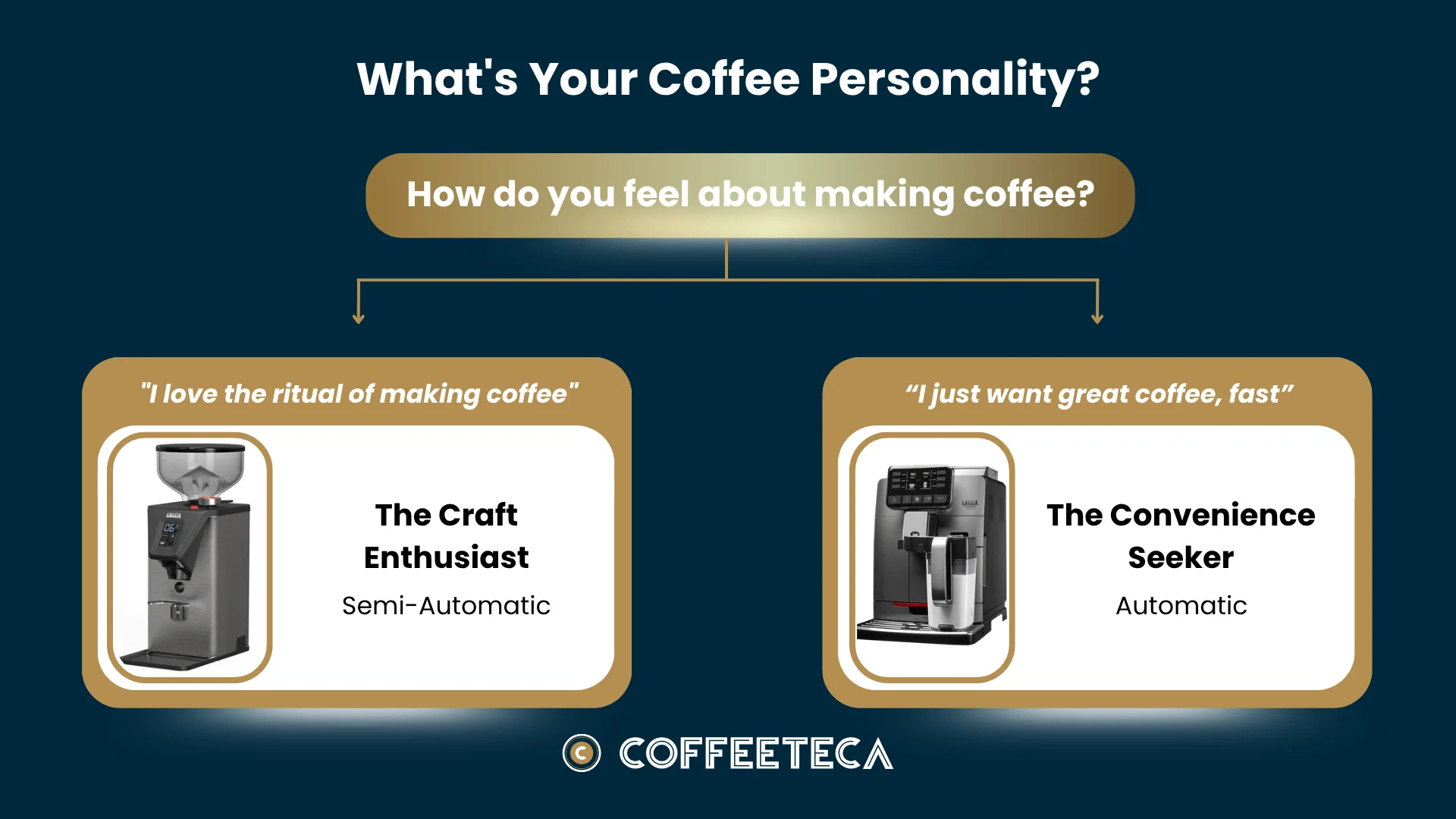
Before looking at price tags or specifications, be honest about your morning routine.
The biggest mistake first-time buyers make is purchasing a highly manual machine when all they really want is a quick coffee before rushing out the door.
Ask yourself:
This hands-on approach lets you tweak variables and pull a shot that rivals your local café.
If your priority is speed and consistency with minimal mess, a fully automatic machine is the smarter choice.
Knowing your coffee personality upfront will immediately narrow down your options and prevent buyer’s remorse.
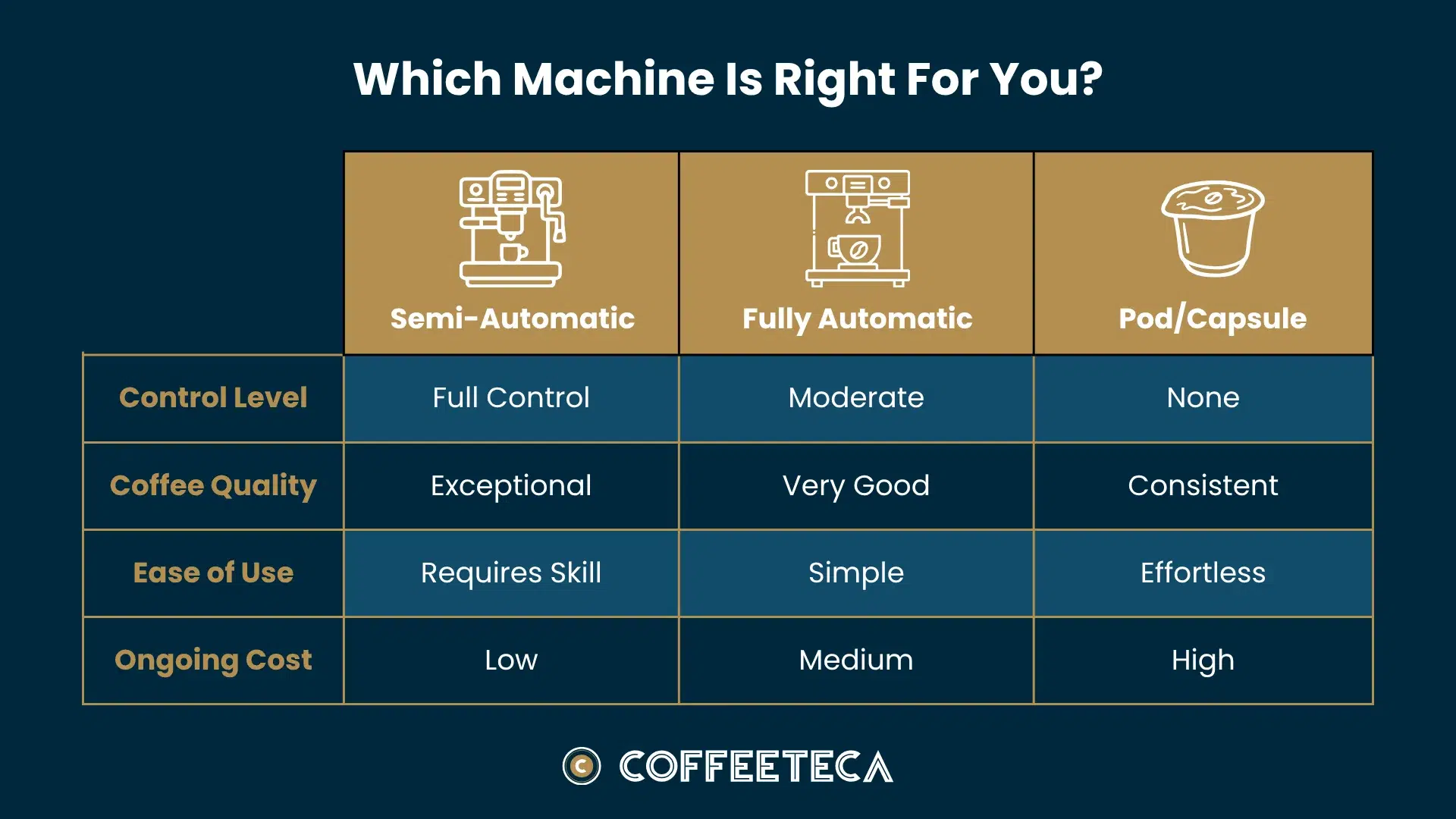
The Australian home coffee market is divided into three main categories. Understanding the differences is the foundation of making the right choice.
These machines most closely resemble what you find in your local café.
You grind the coffee with a separate grinder, tamp it into a portafilter, lock it into the group head, and manually start and stop the water flow.
They offer the highest ceiling for coffee quality because you control the extraction. The trade-off is a genuine learning curve.
Brands like Gaggia, Eureka, and Rocket excel in this space.
Fully automatic machines are the ultimate convenience option.
They feature a built-in grinder and automated brewing system, fill the hopper with beans, top up the water tank, and press a button.
The machine grinds, tamps internally, and extracts the espresso. Many models, including the Dr. Coffee range and the Gaggia Accademia, also handle milk frothing automatically.
The trade-off is less control over the finer details of flavour.
Pod machines offer the lowest barrier to entry. Pre-packaged capsules make coffee quickly and cleanly.
However, the cost per cup is significantly higher than using fresh beans, and the environmental impact of single-use pods is a genuine concern for many Australians.
Coffee quality will also never match the freshness and depth achievable with freshly ground beans.
If you go the semi-automatic route, the next major decision is the boiler type.
The boiler is the engine of your machine, it dictates heat-up time and whether you can brew and steam milk simultaneously.
| Boiler Type | How It Works | Best Suited For |
|---|---|---|
| Single Boiler | One boiler handles both brewing and steaming. You must wait for the temperature to climb after pulling a shot before steaming milk. | Singles or couples who mostly drink black coffee, or those starting on a strict budget. |
| Heat Exchanger (HX) | A single large steam boiler with a copper tube running through it. The tube flash-heats brew water, allowing simultaneous brewing and steaming. | Families, entertainers, and regular milk-coffee drinkers who want a café-style workflow. |
| Dual Boiler | Two entirely separate boilers, one dedicated to brewing, one to steaming. Delivers the ultimate temperature stability and zero wait time. | Serious home baristas who demand precision and high-volume consistency. |
For most first-time buyers, a quality single boiler machine like the Gaggia Classic is the ideal entry point.
If your household drinks multiple flat whites or lattes back-to-back each morning, a Heat Exchanger machine will save you significant time and frustration.
Here is a truth many beginners overlook: your espresso machine is only as good as your grinder. Many coffee professionals argue the grinder is actually the more important piece of equipment.
Coffee beans begin losing their complex flavours and aromas within minutes of being ground.
Buying pre-ground coffee from the supermarket means you are already starting at a disadvantage. To extract a syrupy, rich espresso with a thick crema, you need a grinder capable of producing a fine, uniform, and consistent grind size.
“Never blow your entire budget on the espresso machine while treating the grinder as an afterthought. A $500 machine with a $500 grinder will almost always outperform a $1,000 machine paired with cheap pre-ground coffee.”
Blade grinders, the cheap ones that look like mini blenders, chop beans unevenly and generate heat, degrading the coffee before it even reaches the machine.
Look for dedicated espresso burr grinders like the Eureka Mignon Specialita or the Gaggia MDF, which offer the micro-adjustments necessary to dial in the perfect shot.
This is precisely why Coffeeteca offers curated machine and grinder bundles, so you have the right tools from day one.
Understanding what your money buys at each price point will help you set realistic expectations and avoid disappointment.
| Budget Tier | Machine Only | With a Quality Grinder | What to Expect |
|---|---|---|---|
| Entry | $500–$1,000 | $800–$1,600 | Pressurised baskets, single boiler, great for learning. Gaggia Espresso Evolution sits here. |
| Mid-Range | $1,000–$2,500 | $1,400–$3,000 | Commercial-grade portafilter, powerful steam wand, PID on some models. Gaggia Classic E24 and GT sit here. |
| Premium | $2,500+ | $3,000+ | Heat exchanger or dual boiler, rotary pump, near-commercial performance. Eureka Costanza, Rocket, ECM. |
A common mistake is spending the entire budget on the machine and buying a cheap grinder as an afterthought. Always allocate at least 30–40% of your total budget to the grinder.
Coffeeteca’s bundles are designed with this balance in mind.
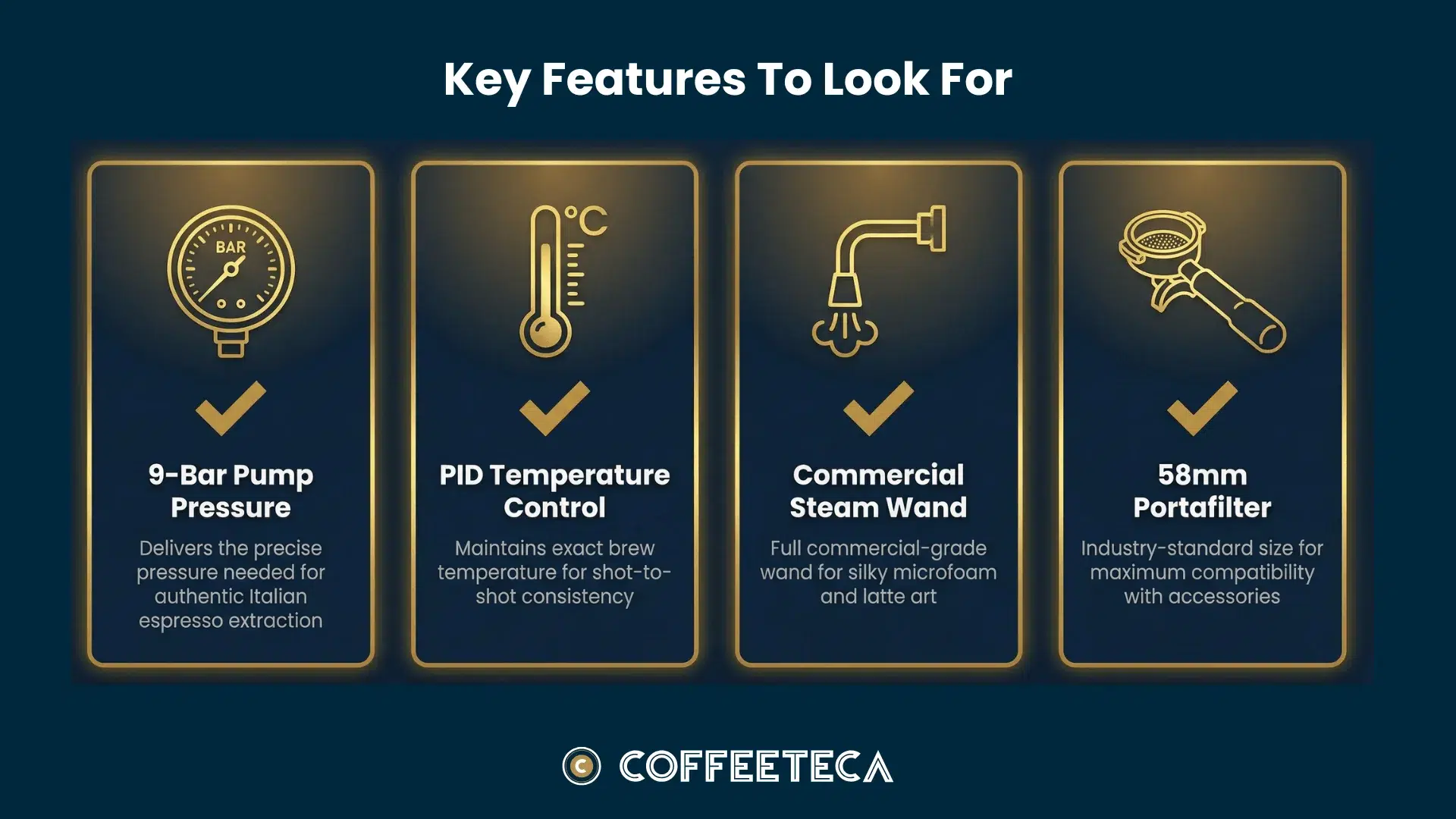
As you compare models, you will encounter a range of technical specifications. Here are the ones that genuinely matter:
Many entry-level machines boast “15-bar” or “20-bar” pumps.
This is largely a marketing tactic. The industry standard for authentic espresso is 9 bars of pressure.
A machine that consistently delivers 9 bars will produce a far more balanced extraction than one pushing water through at 15 bars, which often leads to over-extraction and bitterness.
A PID (Proportional-Integral-Derivative) controller is a digital thermostat that keeps water temperature stable within a fraction of a degree.
Temperature stability is critical for consistent espresso, water that is too hot burns the coffee, while water that is too cold produces a sour, under-extracted shot.
If your budget allows, a machine with a PID is a worthwhile investment.
If you enjoy lattes, cappuccinos, or flat whites, the steam wand deserves close attention.
Avoid thick, plastic “panarello” wands if you want silky, café-quality microfoam. Look for a traditional stainless steel steam wand, ideally mounted on a ball joint so you can angle it precisely into your milk jug.
The portafilter is the handle that holds the coffee.
The commercial standard is 58mm. A machine with a 58mm portafilter gives you access to a wide range of aftermarket accessories, precision tampers, distribution tools, and alternative filter baskets, as your skills develop.
When you buy a semi-automatic machine, it will typically include different filter baskets that sit inside the portafilter. Understanding the difference is important for a first-time buyer.
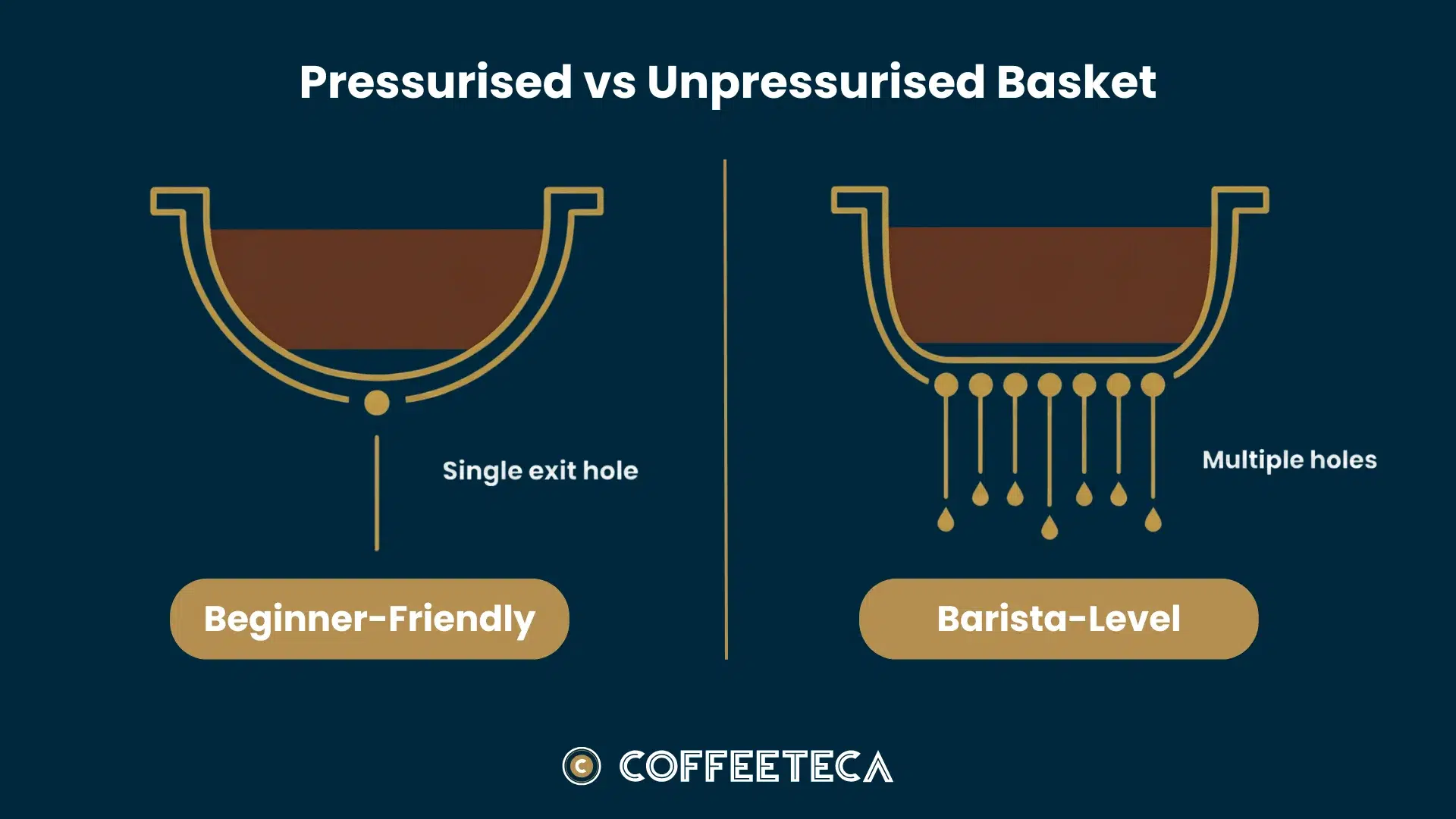
A pressurised basket (also called a dual-wall basket) features a false bottom with a single tiny hole.
This design creates artificial pressure, meaning you can use store-bought, pre-ground coffee and still achieve a layer of crema.
It is highly forgiving and perfect for absolute beginners or those who have not yet purchased a burr grinder.
An unpressurised basket (or single-wall basket) is what professional baristas use.
It relies entirely on the fineness of the coffee grind and the firmness of your tamp to create the necessary resistance against the water pressure.
This basket requires a dedicated espresso grinder and fresh beans, but it is the only way to unlock the true flavour potential of your coffee.
Machines like the Gaggia Classic range include both types of baskets, allowing the machine to grow with you as your skills improve.
Owning an espresso machine is a bit like owning a car, regular maintenance keeps it performing at its best.
Coffee oils build up quickly and turn rancid, ruining the taste of even the best beans. Hard water causes scale buildup inside the boiler, which is a common issue in many parts of Australia.
| Frequency | Task |
|---|---|
| Daily | Purge water through the group head before and after each shot. Wipe and purge the steam wand immediately after use. Empty the drip tray. |
| Weekly | Brush the group head seal and shower screen. Backflush using a blind basket and espresso cleaning powder to remove built-up coffee oils. |
| Monthly / Quarterly | Descale according to the manufacturer’s instructions. Frequency depends on your local water hardness. Using filtered water significantly reduces the need for descaling. |
Based on years of helping Australians find their perfect home setup, here are the Coffeeteca team’s picks for first-time buyers:
Gaggia Espresso Evolution is the ideal starting point for anyone stepping into manual espresso without a large upfront investment.
It is forgiving, easy to use, and comes with a pressurised basket, meaning you can make great coffee immediately with pre-ground beans before upgrading to a grinder later.
A genuinely accessible entry into Italian espresso culture.
Gaggia Classic E24 is arguably the most iconic entry-level espresso machine in the world.
It features a commercial-style 58mm portafilter, a powerful steam wand, and a durable build designed to last for years.
When paired with a quality grinder, the Classic E24 is capable of producing espresso that rivals your favourite local café. It is the machine for someone who wants to learn, improve, and truly master the craft.
Dr. Coffee C11 is for those who want café-style coffee at the touch of a button, it’s a standout fully automatic option.
It handles grinding, tamping, brewing, and milk texturing entirely on its own, perfect for busy households or small offices where convenience and consistency are the priority.
Choosing your first home espresso machine is an exciting step.
By understanding your coffee personality, setting a realistic budget that includes a grinder, and knowing which features actually matter, you are well on your way to leaving the $7 café flat white behind.
Whether you want to dive deep into the craft of espresso with a Gaggia Classic, or you prefer the one-touch convenience of an automatic machine, the team at Coffeeteca is here to help.
We are passionate about matching Australians with the right equipment for their homes, and we back that up with genuine, old-fashioned customer service.
Explore our full range of manual coffee machines and curated machine and grinder bundles online, or get in touch with our team for personalised advice. We are available Monday to Saturday, 9am–5pm.
Happy brewing.
For a reliable manual setup, budget between $500 and $1,500 for the machine, plus an additional $300 to $600 for a quality burr grinder.
Coffeeteca’s machine and grinder bundles are often the most cost-effective way to start.
Yes, if you are buying a semi-automatic machine and want café-quality results.
Freshly ground coffee is the single most important factor in espresso extraction. If a grinder is not in the budget right away, choose a machine that includes a pressurised filter basket so you can use pre-ground coffee in the interim.
This usually means your grind is too coarse or you have not tamped firmly enough.
The water is rushing through the coffee bed without extracting the rich, sweet flavours. Adjust your grinder to a finer setting and try again.
No. Authentic espresso is extracted at 9 bars.
Machines advertising 15 or 20 bars are referring to the maximum pump capacity, not the actual brewing pressure. A machine calibrated to brew at 9 bars will yield a smoother, sweeter espresso.
Both drinks are made with espresso and steamed milk, but a flat white uses less milk and has a higher coffee-to-milk ratio, resulting in a stronger, more intense flavour.
It is also typically served in a smaller cup. The flat white is, of course, an Australian (and New Zealand) invention, and a point of national pride.
Most modern machines will display a descale indicator light when it is time.
As a general rule, if you use tap water, descale every two to three months. If you use filtered water, you can extend this to every four to six months.
Always follow the manufacturer’s specific instructions.