


Free Shipping Australia Wide
Every flat white poured in Australia today traces back to a handful of Milanese workshops and one barista’s stubborn refusal to accept bitter coffee. The story of Italian espresso is not a story about beans. It is a story about pressure, engineering and the people who worked out that forcing hot water through finely ground coffee produces something entirely different from anything steam can make.
Understanding that history is genuinely useful if you are choosing a machine. The names on the counter at your favourite café, and on the machines we stock at Coffeeteca, are not marketing inventions. They are companies with patents, factories and a century of argument behind them.
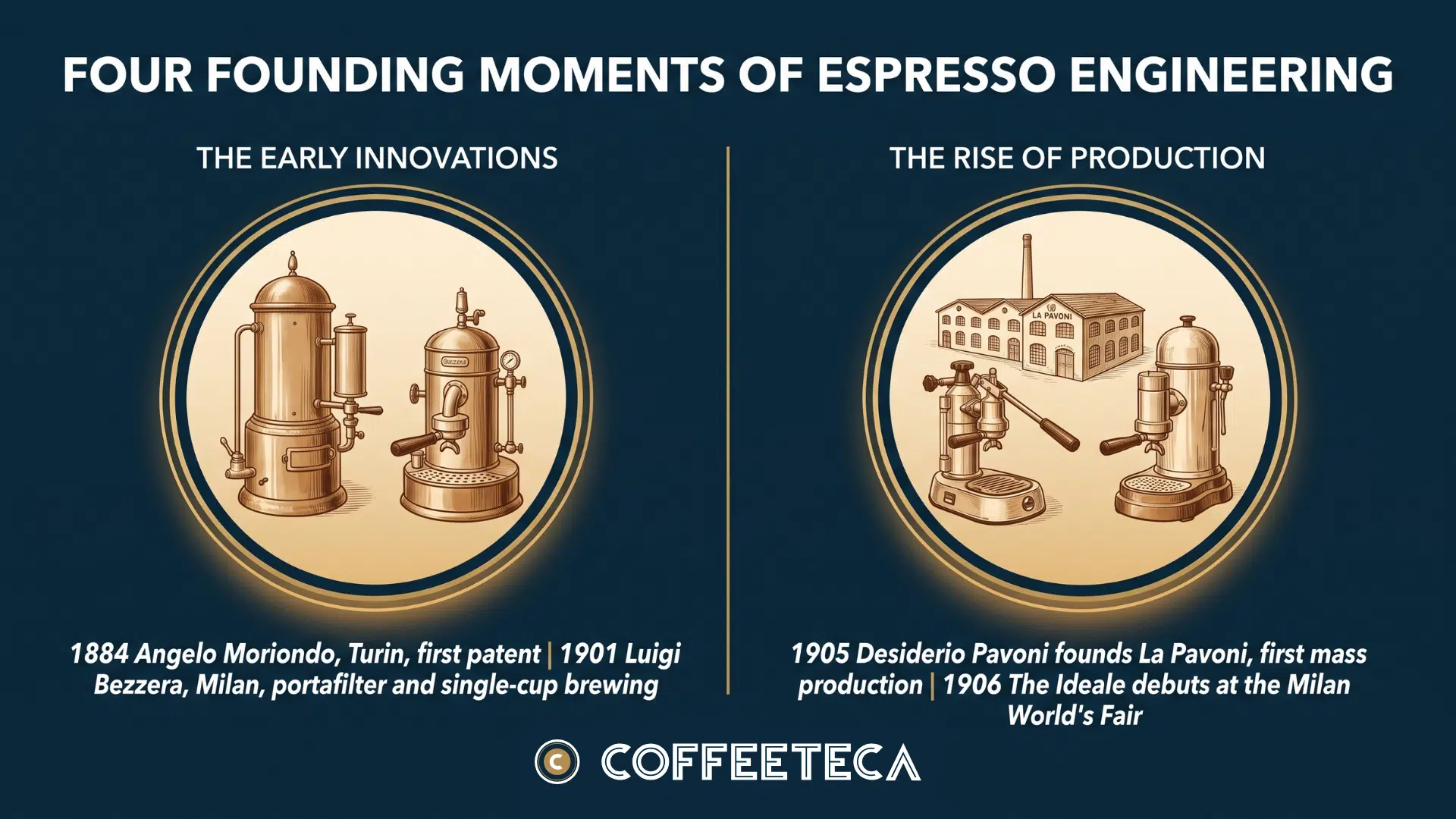
Italian espresso began with Angelo Moriondo’s 1884 patent in Turin, became commercially viable through Luigi Bezzera and Desiderio Pavoni between 1901 and 1906, and took its modern form in 1938 when Achille Gaggia patented a system that replaced steam with pressurised hot water and created crema. Everything since, from the Faema E61 in 1961 to today’s bean-to-cup machines, has refined that basic idea.
| Year | Milestone | Why it mattered |
|---|---|---|
| 1884 | Angelo Moriondo patents a bulk steam-and-water brewer in Turin | First recorded espresso machine patent, though never industrialised |
| 1901 | Luigi Bezzera files his patent in Milan | Introduced the removable portafilter and single-cup brewing |
| 1905 | Desiderio Pavoni founds La Pavoni | First real mass production of espresso machines |
| 1938 | Achille Gaggia files patent no. 365726 for the “Lampo” system | Abandoned steam entirely, using hot water under pressure |
| 1947–48 | Gaggia patents the spring-lever piston and launches the Tipo Classica | Produced crema naturale and the 25–30 second shot |
| 1952 | Gaggia launches the Gilda | First Gaggia machine built for the home |
| 1961 | Faema releases the E61 | Electric pump, thermosiphon and automatic pre-infusion |
| 1961 | La Pavoni launches the Europiccola | Compact direct-lever machine, still in production |
| 1977 | Baby Gaggia arrives, designed with Makio Hasuike | First mass-produced domestic espresso machine |
| 1985 | Saeco launches the Superautomatica | First fully automatic bean-to-cup machine for home use |
| 1991 | Gaggia Classic launches | Professional design language in a domestic stainless steel body |
Coffee reached Italy through Venice in the sixteenth century, and by the 1700s the Italian caffè was already a fixture of public life. The problem was time. Brewing was slow, batches sat and stewed, and the result was heavy and bitter. Achille Gaggia later described the coffee of his youth as tasting like walking into a foggy Milan.
The nineteenth century industrial boom created the pressure that solved it. Factory towns needed workers who could take a break and get back to the line. The word espresso carries both meanings that follow from that: fast, and made expressly for you.
Angelo Moriondo, a Turin businessman from a family of liqueur and chocolate makers, holds the first recorded espresso machine patent, granted on 16 May 1884. His machine used steam and boiling water together and brewed in bulk rather than by the cup. Moriondo never took it to industrial production, so his machines stayed in and around Turin and his name largely dropped out of the story for a century.
The commercial breakthrough came from Milan. Luigi Bezzera, a mechanic, filed a patent on 19 December 1901 for a set of improvements that made the machine practical: brewing group by brewing group, cup by cup, with a removable portafilter that a barista could knock out and refill in seconds. Throughput went up, and so did the economics.
Bezzera was an engineer, not a salesman. Desiderio Pavoni bought the rights, founded La Pavoni in 1905, and began building machines industrially in a small workshop on Via Parini in Milan. The Ideale, La Pavoni’s first model, was presented at the 1906 Milan World’s Fair. That combination of a working patent and a businessman who understood distribution is what turned espresso from a curiosity into an industry.
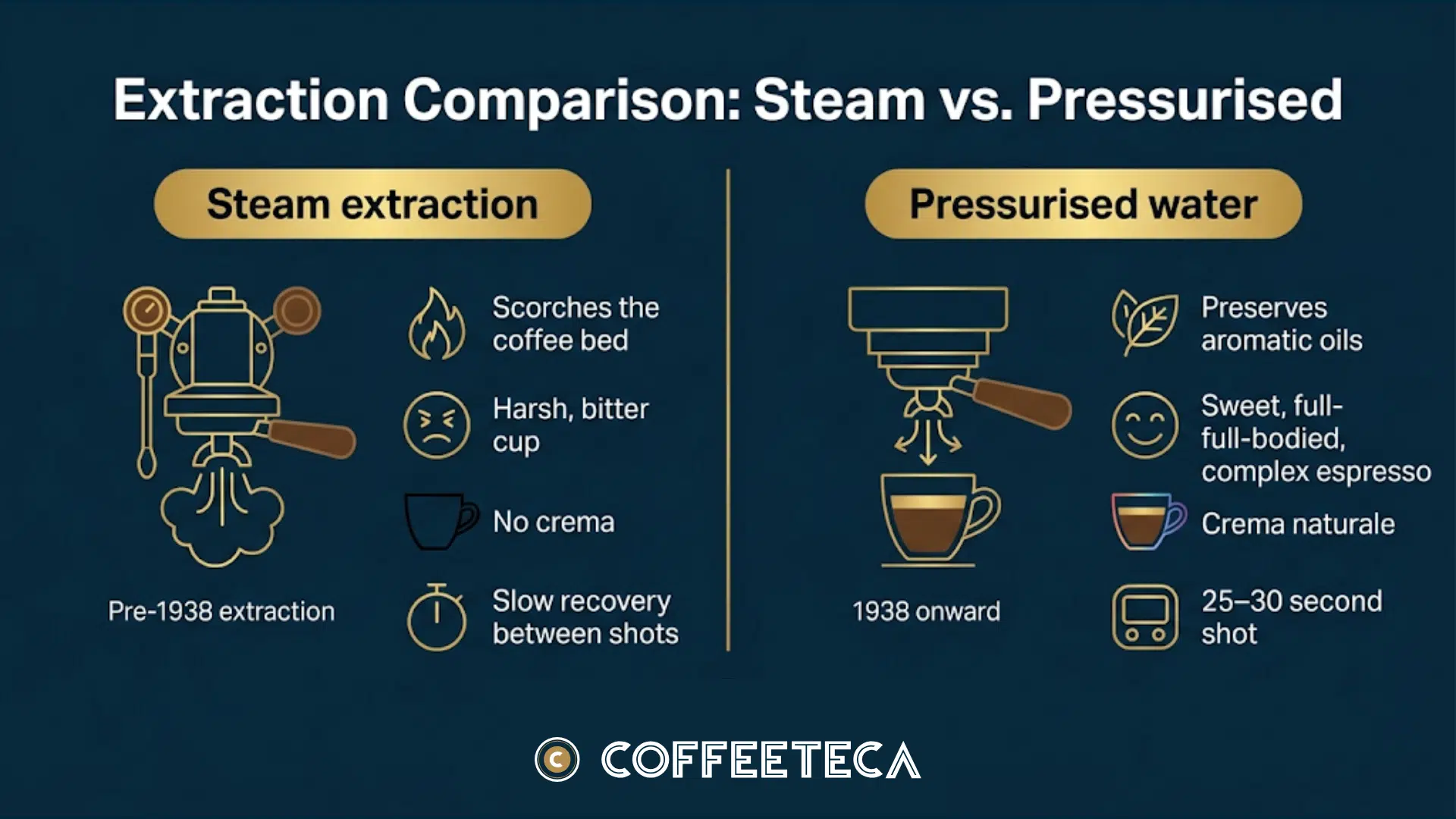
Achille Gaggia invented modern espresso by removing steam from the equation entirely, and crema was the visible proof it had worked.
Gaggia was working in his family’s bar, Caffè Achille on viale Premuda in Milan, when he decided the extraction process itself was the problem. Steam pushed through coffee scorches it and pulls out harsh, bitter compounds. Working with the engineer Antonio Cremonese, he developed a screw-driven system he called a torchio, later renamed Lampo. On 5 September 1938 he filed patent no. 365726.
The Lampo forced hot water, not steam, through the coffee bed under pressure. Gaggia showed it at the 1939 Milan Fiera Campionaria, hoping to sell retrofit groups to bar owners. Almost nobody bought. The only way forward was to build complete machines, and then the war intervened.
The second patent, registered in 1947, is the one that changed cafés. Gaggia added a spring-loaded piston driven by a lever. Company legend attributes the idea to the hydraulic piston system on an American army jeep. The barista pulled the lever to compress the spring, the spring drove the piston, and hot water passed through the grounds at high pressure for 25 to 30 seconds.
In 1948, with the entrepreneur Carlo Ernesto Valente, Gaggia founded Officine Faema Brevetti Gaggia and produced the Tipo Classica. It was as much a design statement as an engineering one: a horizontal body with a row of levers, which meant multiple groups side by side and a barista working front-of-house rather than hidden behind a tower of copper. Pulling shots became a performance.
Gaggia understood exactly how significant this was and marketed it relentlessly. Machines in Milan’s most fashionable bars, Motta and Biffi among them, carried the slogan “Crema caffè naturale, funziona senza vapore”: natural coffee crema, works without steam. Milanese drinkers queued to try it. Crema became the benchmark for a good shot and has remained so for close to eighty years.
The machine changed the architecture of Italian social life. Because a shot took half a minute rather than several, the bar became a place you passed through rather than settled into. Italians drank standing at the counter, exchanged a few words, and left. The word barista itself was popularised in the 1930s as part of a push to Italianise borrowed vocabulary, replacing barman.
Espresso then travelled with people. Post-war Italian emigration carried the ritual to Africa, the Americas and Australia. In London, Gaggia machines went into the Moka Bar, opened by the actress Gina Lollobrigida in 1953, along with Bar Italia and The French House. Some were serving a thousand people a day. Espresso arrived in Britain and Australia not as a beverage trend but as a piece of Italian culture that came with the families who brought it.
Faema, founded in Milan in 1945 by Carlo Ernesto Valente, the same entrepreneur who had partnered with Achille Gaggia, released the E61 in 1961. It was named after the solar eclipse of that year, and it solved the lever’s remaining limitations in one design.
The E61 was the first espresso machine to use an electric pump instead of muscle, the first with a thermosiphon circulating water to keep the group head at temperature, and the first with automatic pre-infusion. Baristas no longer had to pause between shots while a boiler recovered. Just as importantly, the boiler was laid out horizontally, which dropped the height of the machine and let the barista and the customer see each other over the counter. Sixty-five years later, “E61 group” remains a category description rather than a brand.
Espresso history is usually told through machines, which leaves out the fact that no lever or pump can rescue a bad grind. Italy built a parallel grinder industry, largely as suppliers to the machine makers, and those companies are still the ones that matter.
The pattern is the same as the machine story: patents, family workshops, and gradual refinement rather than sudden reinvention. If you want to understand why grind quality is treated so seriously by Italian brands, our guide on how to dial in your espresso grinder covers the practical side.
Gaggia moved into the home in 1952 with the Gilda, a handcrafted, piston-driven machine named after Rita Hayworth’s 1946 film. It was followed by the Tipo-Iris and the Tipo-Gilda 54, nicknamed “rabbit’s ears” for its twin handles.
The real domestic breakthrough came in 1977. The Baby Gaggia, developed with the Japanese designer Makio Hasuike, was the first espresso machine to be genuinely mass produced. Compact, affordable and good enough to make a proper shot, it put café coffee into Italian kitchens and became a design reference in its own right.
Then in 1991 came the Gaggia Classic: a stainless steel body, straightforward controls, commercial-style components and a design that rewarded anyone willing to learn. It has been in continuous production and continuous revision ever since. The Gaggia machines we stock today, including the Classic Evo Pro, the Classic E24 with its brass boiler and the Classic GT, are direct descendants of that 1991 decision to package professional engineering for the home barista.
La Pavoni took a different route to the same destination. In 1961, the same year Faema launched the E61, it released the Europiccola, a compact direct-lever machine for the home, followed by the Professional in 1974. Both are still made, and both still ask the user to do the work by hand. There is a straight line from the 1948 café lever to a La Pavoni lever machine on a kitchen bench in Sydney.
Saeco was founded in 1981 at Gaggio Montano, near Bologna, by the Italian businessman Sergio Zappella and the Swiss engineer Arthur Schmed. In 1985 it released the Superautomatica, the first fully automatic bean-to-cup espresso machine built for the home. One button ground the beans, tamped the dose, brewed the shot and delivered crema.
This was the second genuine break in espresso history. Gaggia had made great espresso possible outside the café. Saeco made it possible without technique. The company added the Cappuccinatore in 1996 for automatic milk texturing, and in 1999 it acquired the majority share of Gaggia, which is why the two names sit together in the modern lineup. In 2009 both passed to Philips.
That inheritance runs directly through today’s automatic coffee machines, including the Gaggia Cadorna and Accademia ranges. Pre-brewing, removable brew groups and adaptive grinding are all refinements of the 1985 idea.
Australia’s coffee culture exists because Italian migrants brought Italian machines with them in the 1950s, and Melbourne got there first.
Peter Bancroft secured the agency to import Gaggia machines into Australia in the early 1950s. According to the Melbourne History Workshop, his first customers were Gianni Milani of the University Café in Carlton and the brothers Leo and Vildo Pellegrini, both former waiters at the Florentino on Bourke Street. Bancroft opened Melbourne’s first dedicated espresso café, Il Capuccino, on Fitzroy Street in St Kilda on 1 May 1954.
Pellegrini’s Espresso Bar opened at 66 Bourke Street the same year and is still trading. Its claim to Melbourne’s first espresso machine is contested, since several Lygon Street cafés installed machines at around the same time, but it was almost certainly the first in the CBD. The Florentino had run a machine since the 1920s, but it was a steam machine, which by the post-Gaggia definition was not making espresso at all.
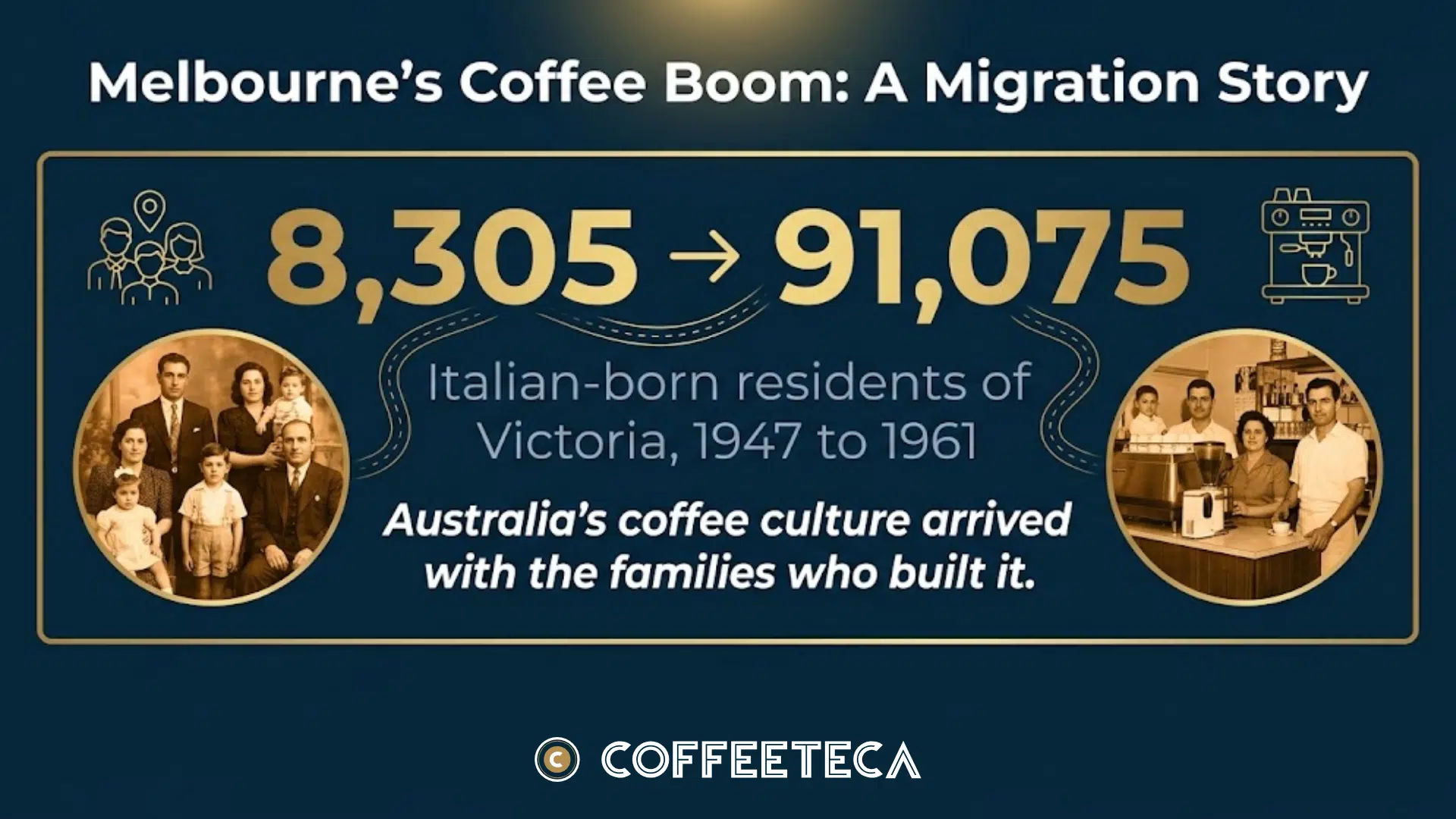
The scale of the migration explains the speed. Between 1947 and 1961, the number of Italian-born residents in Victoria rose from 8,305 to 91,075. Don Camillo on Victoria Street, the Lexington Café on Exhibition Street and the Universita Café on Lygon Street all opened between 1953 and 1955. In 1954 Agostino Monaci, Vic Panatieri and Sergio Coperchini founded Mocopan. A coffee industry appeared in Melbourne inside a decade.
Gaggia’s Australian connection ran deeper still. The Montecarlo, a bar machine produced in Australia, represented the brand here for more than twenty years and did much of the work of spreading crema culture nationally.
For home enthusiasts looking to recreate that espresso tradition, manual coffee machines offer hands-on control, while a quality coffee grinder remains essential to achieving a consistent extraction. For those wanting both in one setup, machine and grinder bundles make it easier to build a complete home espresso station.
What Australia did next was to take the Italian foundation and diverge from it. Italians drink espresso standing, quickly, usually black. Australians built a milk culture on top of the same equipment, and the flat white, roughly 160ml with a thin layer of textured milk, became the national default. Australian baristas turned café work into a skilled profession and began winning world championships in the late 2000s.
That inheritance is why the Australian home espresso market looks the way it does. Buyers here expect Italian engineering and milk-drink capability in the same machine, which is exactly the brief the Gaggia Classic line and its peers were built for.
The companies that built espresso are, for the most part, still the companies making it. This is unusual in any consumer category and it is the reason heritage is a practical buying signal rather than a sentimental one.
| Brand | Founded | Historical contribution | What it makes now |
|---|---|---|---|
| La Pavoni | Milan, 1905 | First industrial production of espresso machines; the Ideale | Direct-lever home machines including the Europiccola and Professional |
| Eureka | Florence, 1920 | Century-long specialist in espresso grinding | Hand-assembled grinders and, since 2025, the Pura and Costanza machines |
| Quick Mill | Italy, 1945 | Post-war domestic and prosumer machine building | Prosumer manual espresso machines |
| Gaggia | Milan, patent 1938, company 1948 | Replaced steam with pressurised water and created crema | Classic Evo Pro, Classic E24, Classic GT, Cadorna and Accademia ranges |
| Mazzer | Venice, late 1940s | Defined the commercial café grinder | Commercial and prosumer grinders |
| Saeco | Gaggio Montano, 1981 | First home bean-to-cup machine, 1985 | Super-automatic machines |
| WEGA | Italy, 1985 | Commercial bar machines built for volume | Professional and prosumer machines |
Between them, Italian manufacturers still control the large majority of the global commercial espresso machine market. When you buy a machine from one of these companies you are buying an accumulated argument about extraction that has been running since 1884.
Italians drink espresso standing at the bar, black, and quickly. A few conventions are worth knowing, if only because they explain the design decisions behind the machines.
Coffeeteca was founded by Andrew and Alfonso, whose Italian family heritage sits behind a simple belief: there is nothing better than sharing time with someone over a genuinely good coffee, and a good coffee starts with a great machine. That is why the range is built around the companies in this article rather than around whatever is cheapest to import.
If you are choosing your first machine, the lever-descended manual coffee machines give you the control Achille Gaggia was chasing, while the automatic coffee machines carry Saeco’s bean-to-cup lineage. Either way, pair it with a proper coffee grinder, because a century of Italian engineering agrees that the grind is where espresso is won or lost. Our machine and grinder bundles put both together, and if you are not sure where to start, get in touch and we will talk you through it.
Angelo Moriondo of Turin holds the earliest recorded espresso machine patent, granted in 1884, but he never took it to production. Luigi Bezzera’s 1901 patent made the machine commercially practical, and Desiderio Pavoni brought it to market through La Pavoni from 1905. Achille Gaggia’s 1938 and 1947 patents created the modern espresso we recognise today.
Gaggia replaced steam with hot water under pressure, which produced crema and transformed espresso from a bitter, fast drink into a sweet, full-bodied one. Achille Gaggia’s 1938 patent is generally treated as the start of the modern espresso era, and his spring-lever design of 1947 set the template that pump machines later automated.
Crema is an emulsion of coffee oils and dissolved carbon dioxide that forms only when water is forced through the coffee bed at high pressure. A dense, even, hazelnut-coloured crema indicates fresh coffee and a correct extraction. Thin, pale or rapidly disappearing crema usually points to stale beans or a grind problem.
Italian espresso machines arrived in Australia in the early 1950s, when Peter Bancroft secured the Gaggia import agency. Melbourne’s first dedicated espresso café, Il Capuccino in St Kilda, opened on 1 May 1954, and Pellegrini’s Espresso Bar opened on Bourke Street the same year. Post-war Italian migration drove the expansion.
Gaggia is an Italian company headquartered at Gaggio Montano in the province of Bologna, and its manual machine range including the Classic line continues the design lineage established in Milan. The brand is now part of the Evoca Group, following ownership by Saeco from 1999 and Philips from 2009.
A manual machine is closer to the traditional method, because you control grind, dose, tamp and timing the way a barista does. An automatic bean-to-cup machine follows the Saeco tradition instead, which was itself an Italian innovation designed to deliver consistent espresso without technique. Both are authentic descendants of the same history, and the right choice depends on whether you want the ritual or the result.