


Free Shipping Australia Wide
With the price of a daily flat white creeping past the $7 mark in many Australian cities, the maths of buying a home espresso machine has never made more sense.A household of two purchasing daily coffees can easily spend over $4,500 a year at the local café. Investing in a quality home setup is no longer a luxury; it is a smart financial decision that pays for itself, often within the first year.However, stepping into the world of home espresso can feel like learning a new language. Between pump pressures, PID controllers, and group heads, it is easy to become overwhelmed.
The single most important decision you will make—the choice that dictates your daily workflow, the speed of your morning routine, and the consistency of your coffee—is the type of boiler inside the machine.
This guide cuts through the technical jargon to help you choose between a single boiler and a dual boiler espresso machine. We will explore how each system works, what your money actually buys at different price points, and how to select the right investment for your home. If you are just starting your coffee journey, you may also want to read The Ultimate Guide to Choosing Your First Home Espresso Machine in Australia.
The boiler is the heart of any espresso machine. It is essentially a sealed metal chamber—typically made from aluminium, stainless steel, brass, or copper—that uses an electric heating element to bring water up to the precise temperature required for your coffee.
Making a milk-based coffee like a latte or flat white requires water at two very different temperatures. To extract the perfect espresso shot, water needs to be around 90–96°C. However, to generate the steam pressure needed for frothing milk, water must be heated significantly higher, typically around 125–130°C.
Understanding how different machines solve this temperature problem is the key to finding the right setup for your lifestyle. There are three main approaches: single boiler, heat exchanger, and dual boiler.
| Boiler Type | How It Works | Workflow | Temperature Stability | Typical Price Range (AUD) |
|---|---|---|---|---|
| Single Boiler | One boiler handles both brewing and steaming sequentially | Wait 60–90 seconds between tasks | Good (±3–5°C without PID) | $429 – $2,599 |
| Heat Exchanger (HX) | One steam boiler with a tube that flash-heats brew water | Near-simultaneous brew and steam | Very Good (with cooling flush) | $1,500 – $3,800 |
| Dual Boiler | Two separate boilers, one for brew, one for steam | Fully simultaneous | Excellent (±0.5°C with PID) | $2,500 – $4,200+ |
A single boiler espresso machine uses one heating chamber to handle both tasks. Because the machine cannot be at two temperatures simultaneously, it operates sequentially.
You extract your espresso shot first at the lower brewing temperature. Then, you flick a switch and wait for the boiler to heat the remaining water up to steam temperature.
This transition typically takes between 60 and 90 seconds. Once you have frothed your milk, you must wait again for the boiler to cool back down before you can pull another shot.
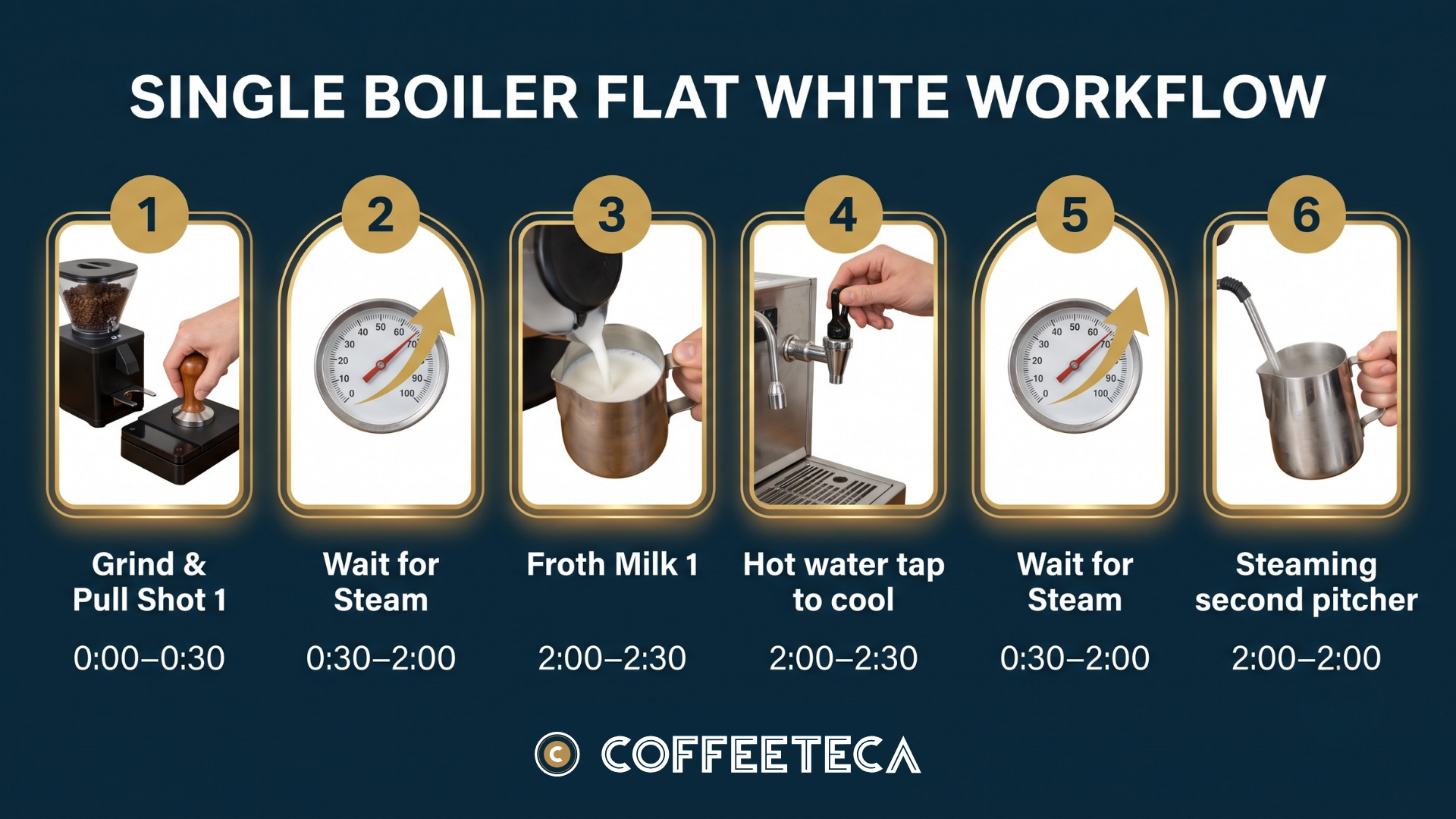
Imagine a typical Saturday morning where you need to make two flat whites for yourself and your partner. Here is what the workflow looks like on a single boiler:
Total time for two drinks: approximately 7–9 minutes.
This sequential process is perfectly manageable for a single coffee drinker or a couple who is not in a rush. The coffee quality itself is not compromised; you are simply trading time for a lower purchase price.
However, if you regularly entertain guests or have a busy household all wanting coffee at the same time, this workflow can become frustrating.
Single boiler machines are the ideal entry point into true home espresso. They are more affordable, take up less counter space, and use less electricity. If you predominantly drink straight espresso, long blacks, or Americanos, you will rarely need to steam milk at all, making the sequential workflow a non-issue.
At Coffeeteca, the Gaggia Classic E24 is our most popular mid-range single boiler. It features a commercial-style 58mm portafilter, a powerful steam wand, and exceptional Italian build quality that will last for years.
Available in multiple colours, it is a machine that looks stunning on any kitchen bench and grows with you as your barista skills develop.
For those on a stricter budget, the Gaggia Espresso Evolution offers a fantastic starting point at under $500, while the premium Gaggia Classic GT steps things up with PID temperature control and a dual boiler design for those ready to invest in the best.
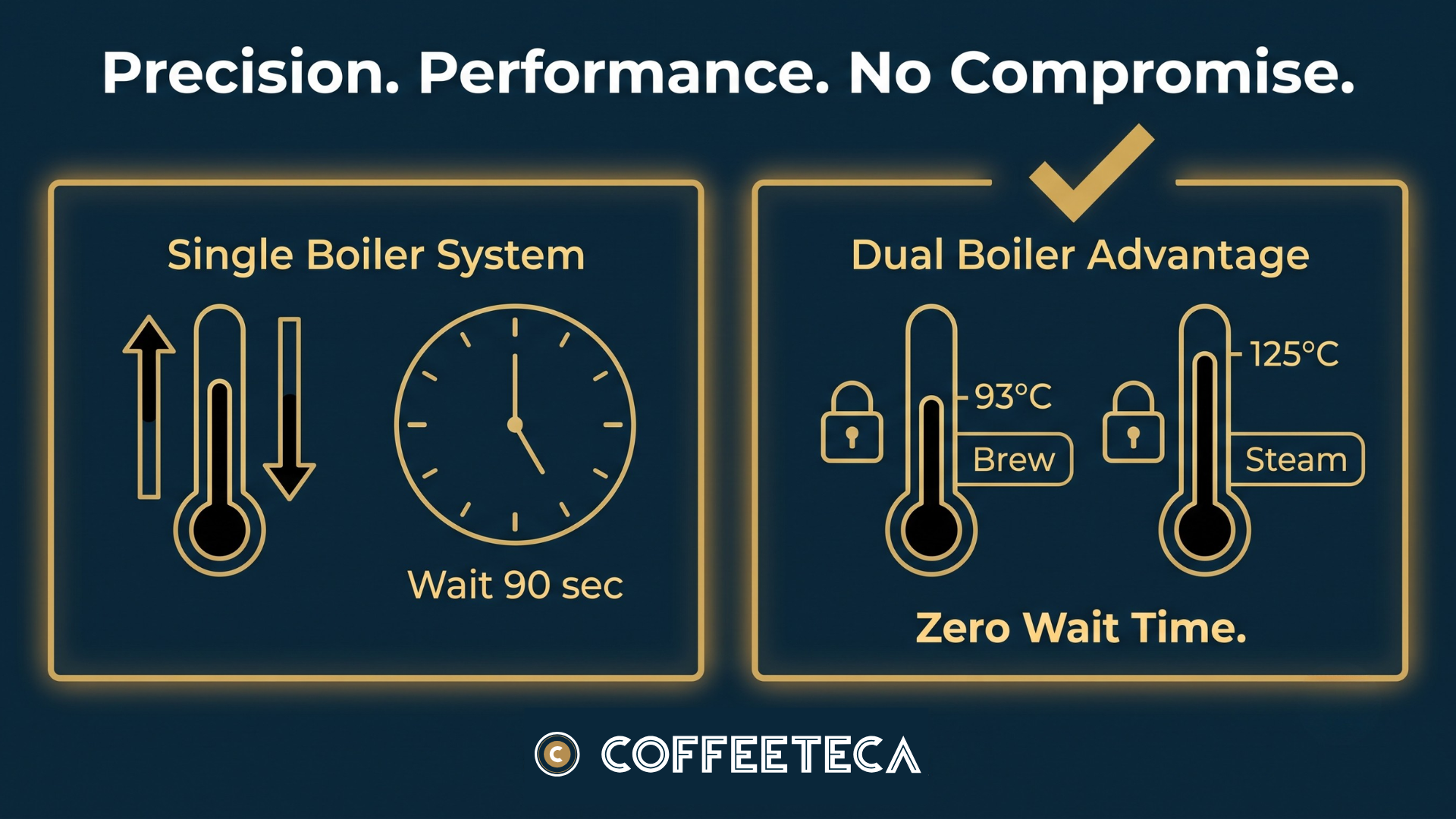
As the name suggests, a dual boiler machine features two entirely separate heating chambers. One boiler is dedicated exclusively to brewing espresso, locked precisely at your target extraction temperature.
The second boiler is dedicated solely to producing steam, constantly held at a high temperature and ready to go the moment you open the steam valve.
This design eliminates the waiting game entirely. You can extract a shot of espresso with one hand while texturing milk with the other, exactly as a professional barista does in a café.
Returning to our Saturday morning scenario, here is what making two flat whites looks like on a dual boiler:
Total time for two drinks: approximately 3–4 minutes.
Beyond speed, dual boilers offer unparalleled temperature stability. Because the brew boiler never has to fluctuate to create steam, it maintains a rock-solid temperature within ±0.5°C (when paired with a PID controller).
This ensures that every shot you pull tastes as balanced and delicious as the last.
Furthermore, the dedicated steam boiler provides powerful, consistent steam pressure, making it significantly easier to achieve that silky, café-quality microfoam required for latte art.
If you make milk-based coffees daily, regularly brew for a household of three or more, or simply want the best possible consistency without any waiting, a dual boiler is the right investment.
While they require a higher initial outlay and take up a larger footprint on your kitchen bench, the workflow improvements are substantial.
For serious home baristas, the Quick Mill Elevate V Dual Boiler offers near-commercial performance with Italian craftsmanship at its core.
The Eureka Costanza R pairs a dual boiler with a rotary pump for whisper-quiet operation and the ability to plumb directly into your water line.
Both machines are built to last a lifetime and provide the ultimate control over your coffee.
There is a third option that sits between the two, and it deserves serious consideration: the Heat Exchanger (HX).
An HX machine features one large boiler that is kept constantly at steam temperature. Running through the centre of this hot boiler is a copper or stainless steel tube.
When you activate the pump to make coffee, fresh cold water is drawn from the tank and pushed through this tube. The water flash-heats as it passes through the steam boiler, arriving at the group head at approximately the correct temperature for brewing espresso.
This clever piece of Italian engineering allows you to brew and steam with minimal interruption, just like a dual boiler, but without the cost and footprint of two separate heating elements.
The trade-off is slightly less precise temperature control compared to a true dual boiler.
Most experienced HX users perform a quick “cooling flush” before their first shot of the day—running a few seconds of water through the group head to stabilise the temperature. Once you develop this habit, it becomes second nature.
For many Australian households, an HX machine hits the perfect sweet spot between price, performance, and workflow speed.
At Coffeeteca, the Quick Mill Rubino Plus and the Quick Mill Aquila Plus are outstanding examples of what modern heat exchanger technology can deliver.
As you compare machines across these boiler categories, you will encounter a range of technical specifications. Here are the ones that genuinely impact your daily coffee experience.
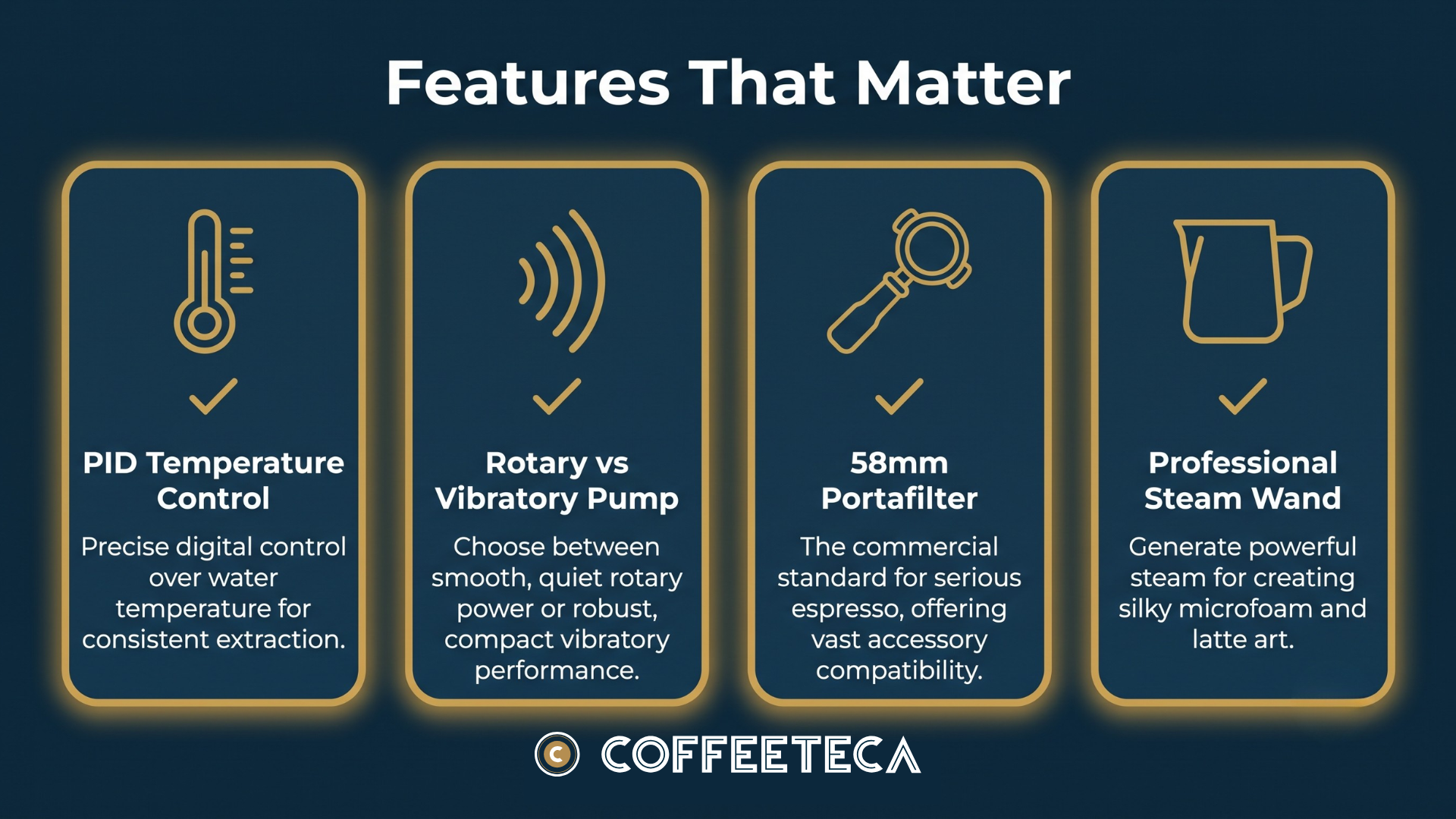
A PID (Proportional-Integral-Derivative) controller is a digital thermostat that reads the boiler temperature continuously and adjusts the heating element to hold a precise target.
Without PID, a boiler cycles on and off in a simple pattern, producing temperature swings of 3–5°C around the set point. With PID, that variance drops to under 1°C.
Temperature stability directly affects extraction. Water that is too hot burns the coffee, producing bitterness. Water that is too cold produces a sour, under-extracted shot. If your budget allows, a machine with PID is a worthwhile investment for consistency.
Most home espresso machines use a vibratory pump. They are compact, affordable, and perfectly capable of producing the 9 bars of pressure required for espresso. However, they can be noisy and have a limited lifespan compared to rotary pumps.
Rotary pumps, found on premium machines like the Eureka Costanza R, are whisper-quiet, more durable, and allow you to plumb the machine directly into your kitchen water line for an uninterrupted water supply. They are the standard in commercial cafés.
The portafilter is the handle that holds your coffee grounds.
The commercial standard is 58mm. A machine with a 58mm portafilter gives you access to a wide range of aftermarket accessories—precision tampers, distribution tools, and alternative filter baskets—as your skills develop.
All Gaggia Classic and Quick Mill machines at Coffeeteca feature this industry-standard size.
If you enjoy lattes, cappuccinos, or flat whites, the steam wand deserves close attention. Avoid thick, plastic “panarello” wands if you want silky, café-quality microfoam. Look for a traditional stainless steel steam wand, ideally mounted on a ball joint so you can angle it precisely into your milk jug.
When deciding between boiler types, it helps to view the purchase over a five-year timeframe.
A quality Italian-made espresso machine is not a disposable appliance; with proper care, it will serve you for a decade or more.
Consider a typical Australian household consuming four coffees a day (two people having two coffees each). At $6.50 per coffee at a café, that is $26 a day, or approximately $9,500 a year. Over five years, that household spends close to $47,500 on takeaway coffee.
| Investment Tier | Example Setup | Initial Cost (Machine + Grinder) | Approx. Cost Per Cup | 5-Year Total Cost (Inc. Beans & Maintenance) | 5-Year Savings vs Café |
|---|---|---|---|---|---|
| Entry Single Boiler | Gaggia Espresso Evolution + Gaggia MDF Grinder | ~$1,100 | ~$0.60 | ~$5,500 | ~$42,000 |
| Mid-Range Single Boiler | Gaggia Classic E24 + Eureka Specialita (Bundle) | ~$1,800 – $2,200 | ~$0.70 | ~$7,200 | ~$40,000 |
| Heat Exchanger | Quick Mill Rubino Plus + Premium Grinder | ~$3,800 – $4,200 | ~$0.85 | ~$10,000 | ~$37,500 |
| Prosumer Dual Boiler | Quick Mill Elevate V + Premium Grinder | ~$4,200 – $5,000 | ~$0.95 | ~$11,500 | ~$36,000 |
Cost per cup estimates include equipment amortised over 5 years, plus specialty coffee beans ($40–$55/kg), electricity, water filters, and cleaning supplies.
Even if you invest in a premium dual boiler setup costing close to $5,000, the equipment pays for itself in approximately six months compared to daily café visits.
The question is not whether you can afford a good machine, but rather which machine will provide the workflow and consistency that ensures you actually enjoy using it every single morning.
It is a common mistake to allocate your entire budget to the espresso machine while treating the grinder as an afterthought. In reality, your espresso machine is only as good as the coffee grounds you feed into it.
To extract a syrupy, rich espresso with a thick crema, you need a dedicated burr grinder capable of producing a fine, uniform, and consistent grind size.
Pre-ground coffee from the supermarket loses its complex flavours within minutes of being ground and will never produce café-quality results, regardless of whether you own a single or dual boiler.
A $1,000 single boiler machine paired with a high-quality $800 grinder will almost always outperform a $3,000 dual boiler paired with cheap, pre-ground coffee.
When budgeting for your setup, aim to allocate at least 40% of your total budget to the grinder.
Look for dedicated espresso grinders with stepless micro-adjustments, such as the Eureka Mignon Specialita or the Gaggia MDF. These grinders offer the precision needed to dial in the perfect shot and adjust for different bean origins and roast profiles.
This is precisely why Coffeeteca offers curated machine and grinder bundles, ensuring you have the right tools from day one while saving money on the combined purchase.
Rather than getting lost in specifications, match the machine to your lifestyle. Here is a straightforward framework based on how you actually drink coffee.
| Your Situation | Recommended Boiler Type | Why | Coffeeteca Recommendation |
|---|---|---|---|
| Mostly drink black coffee (espresso, long black, Americano) | Single Boiler | You rarely need steam; invest savings in a better grinder | Gaggia Classic E24 + Eureka Specialita |
| One or two milk drinks a day, not in a rush | Single Boiler with PID | The wait is manageable; PID ensures shot consistency | Gaggia Classic GT |
| Daily milk drinks, value a fast workflow | Heat Exchanger | Near-simultaneous operation without dual boiler cost | Quick Mill Rubino Plus |
| Multiple milk drinks daily, brew for a household | Dual Boiler | Zero wait time, ultimate consistency, handles volume | Quick Mill Elevate V |
| Entertaining regularly, want café-level performance | Dual Boiler with Rotary Pump | Whisper-quiet, plumbable, commercial-grade steam | Eureka Costanza R |
Owning a quality espresso machine is akin to owning a reliable car; regular maintenance keeps it performing at its best and protects your investment for years to come.
Coffee oils build up quickly and can turn rancid, ruining the taste of even the best locally roasted beans. A simple daily routine of flushing the group head and wiping down the steam wand after each use is essential.
Weekly backflushing with a dedicated espresso machine cleaner will keep the internal valves clear and your coffee tasting fresh.
In Australia, water hardness varies significantly by region. Cities like Adelaide and parts of Melbourne have notably hard water, while Sydney tends to be softer.
Hard water causes calcium scale to build up inside the boiler, which can affect temperature stability and eventually block internal pipes.
Dual boiler machines have more internal plumbing and two heating elements, meaning descaling is slightly more involved than with a single boiler.
However, using filtered water—either through a jug filter or an inline filter—is the easiest way to protect any machine, regardless of the boiler type you choose. Most manufacturers recommend descaling every three to six months, depending on your water quality.
One of the key advantages of investing in a quality Italian-made machine is longevity.
Brands like Gaggia, Quick Mill, and Eureka use commercial-grade materials—brass boilers, copper heating elements, and stainless steel housings—that are designed to last 10 to 20 years with proper care. To learn more about the heritage behind these brands, check out our deep dive into Gaggia & Eureka: Italian Excellence. Replacement parts are readily available, and these machines are designed to be serviced rather than discarded.
Choosing the right espresso machine is an exciting step toward better coffee and significant financial savings.
The boiler type you select will shape your daily routine for years to come, so it pays to get it right.
If you drink your coffee black, or only make the occasional milk drink and want to keep your investment focused, a single boiler machine like the Gaggia Classic E24 is a brilliant, capable choice that will reward your developing skills for years.
If lattes and cappuccinos are a daily non-negotiable, and you value a fast, seamless morning workflow, stepping up to a dual boiler or heat exchanger machine will transform your home barista experience.
The Quick Mill Elevate V and Eureka Costanza R represent the pinnacle of what is possible in a home kitchen.
Whether you want to dive deep into the craft of espresso or simply want a reliable machine that delivers a great cup every time, the team at Coffeeteca is here to help.
We stock only the finest Italian-made machines and grinders, and we pride ourselves on offering genuine, old-fashioned customer service to help you make the right choice.
Browse our extensive range of manual coffee machines online, explore our value-packed machine and grinder bundles, or get in touch with us today for personalised advice tailored to your coffee habits.
A single boiler uses one heating chamber for both brewing espresso (around 93°C) and generating steam for milk (around 125°C).
Because it cannot do both simultaneously, you must wait 60 to 90 seconds between extracting your shot and frothing milk. A dual boiler has two completely separate chambers, each held at its optimal temperature, allowing you to brew and steam at the same time with zero wait.
If you make milk-based drinks daily or regularly make coffee for multiple people, a dual boiler is absolutely worth the investment.
The faster workflow saves several minutes each morning, and the superior temperature stability means more consistent, better-tasting espresso shot after shot.
For households spending $9,000+ per year on café coffees, even a premium dual boiler setup pays for itself within six months.
Yes, you can make excellent lattes with a single boiler machine. The quality of the espresso and milk texture is not inherently compromised.
The trade-off is time: you simply need to be patient while the boiler transitions between brew and steam temperatures.
For one or two drinks, this is perfectly manageable.
A high-quality, Italian-made espresso machine from brands like Gaggia, Quick Mill, or Eureka is built with commercial-grade components including brass, copper, and stainless steel.
With regular cleaning and descaling, these machines routinely last 10 to 20 years.
Replacement parts are widely available, and the machines are designed to be serviced rather than replaced.
A heat exchanger (HX) machine uses one large boiler kept at steam temperature, with a separate tube running through it that flash-heats fresh water to brew temperature on demand.
This allows near-simultaneous brewing and steaming without the cost of a second boiler. It is an excellent middle ground between a single boiler and a dual boiler.
An Australian household buying four coffees a day at $6.50 each spends approximately $9,500 per year.
Making the same coffees at home with quality beans costs roughly $0.60–$0.95 per cup depending on your setup, or approximately $900–$1,400 per year.
Even including the cost of equipment amortised over five years, most households save between $36,000 and $42,000 over that period.
Yes. A dedicated burr grinder is essential for achieving café-quality espresso.
Coffee beans begin losing their complex flavours within minutes of being ground.
Pre-ground coffee will never produce the rich crema and balanced flavour that freshly ground beans deliver. Aim to allocate at least 40% of your total budget to the grinder.
Daily maintenance involves purging the group head and wiping the steam wand after each use.
Weekly, you should backflush with espresso machine cleaning powder. Every three to six months (depending on your water hardness), descale both boilers to remove calcium buildup.
Using filtered water significantly reduces scale formation and extends the life of your machine.